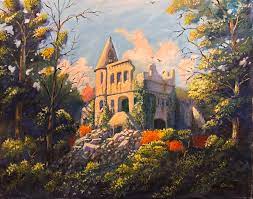
Chapter 2 – The Undercroft – 1959
She felt a gush of relief at the first sight of what was to be her new home. Perhaps she could participate in Ian’s fantasy after all. This gate, massive and rusty, had fallen back against its stone surround and was an open invitation to a fairy tale. She saw something she knew Ian could never have resisted: this twisted iron was surmounted by a pair of stone wyverns. Ian had always claimed the wyvern as his “power creature”. Anything for sale in the town of Wyvern-on-Wye would be of interest to Ian. Was the town named after the house or the other way around?
Whichever was true, she knew he’d claim the whole town as his by right. When she gasped out loud at the sight of their new castle Ian rippled with the same lordly pleasure he demonstrated on skillfully dispensing an orgasm. There it was, at the end of a curving drive, Wyvern House, miniature alcazar toppling on its hill, as if the earth itself would sink beneath its weight.
“My goodness,” she muttered, thinking, as she knew he did, how impressed future guests would be, especially if they could clear away the brambles, re-paint the gates and set the slipping wyverns more solidly, less threateningly aloft.
Up close, the “castle” proved considerably less commanding, revealing unpointed brick, mucky stucco, bleeding windows and muddy drive. Over the double front doors was carved a date which threw it completely out of the running for any claim to aristocracy: “1892: Magnus Bronfen”.
“Soap manufacturer,” said Ian. “All soap manufacturers dream of castles, apparently. How else could you get a castle and six acres for nine thousand pounds?”
She shuddered at the sum. Neither his family nor hers had ever seen so much money. In their five years together they had barely cleared a thousand pounds, and owed more than that. If she succumbed to this place what time would be left for working out her complex themes of literature? She had seen nothing encouraging, so far, about the financial viability of her productions in general.
Ian himself was not doing much better with his proposal for a “modern mythology” TV series. They would be thrown back on Ian’s first idea: using his supernatural “imp” to win a football pool. Or her secret, most private fancy; writing an explosive novel that told the truth about women’s experience. The one time she had mentioned it Ian had been very clear that he considered “women’s fiction” a literary disgrace.
“Plus, the novel’s dead. Plays are the thing, Angry Young Men and all that. Look! There is a garden. You could start a market garden. I’ve heard these roses were famed far and wide.”
What had she ever done to make him think she longed to garden? But “rosarian” certainly was a better title than “hausfrau.” Much better. At this time of year, the overgrown garden offered nothing to see, but it was walled; the walls covered with the same brambly vines that were eating up the gate. They should be replaced with, say, espaliered fruit trees. By somebody. Someday.
To her relief, inside she saw an ordinary house without the unlivable discomforts of an actual castle. The front hall was rather splendid with a huge creaky oak staircase that shed sawdust (deathwatch beetle!) when walked upon but the large rooms were blessed with electric light and there were four generous bathrooms: three second floor and one down.
“I don’t think they spent a penny on the place after building it,” said Scarlet.
“I’m sure they didn’t,” Ian agreed. “This Magnus guy died almost immediately. The current heir lives in town – I don’t think he has a sou but what I gave him. He says the place has been for sale – slowly dropping in price — his entire life.”
It always impressed Ian to consult a “magic moment”. He was beginning to think he was a magic moment, himself. A fatalistic man, with a strong sense of “destiny”, he’d carefully consulted his horoscope before marrying Scarlet. The stars, and a general English misapprehension that all Americans were rich, had pushed him over the edge.
“He only has what the bank gave him,” Scarlet longed to correct, but didn’t. Their marriage was the envy of their friends because neither of them – ever gave in to cracks like that. Ian had repeatedly stated his opinion that “money” was an imaginary concept anyway, created in the modern world by mere promises to buy and sell. Failing to leap aboard the mad carousel, you made certain of being left behind.
Sixty-six years without improvements or upkeep should certainly give any buyer pause, thought Scarlet. What Horrible Secret – probably more than one – was this house hiding? Drains? Vermin? As if reading her thoughts – which he probably was, because marriage made a person good at that — Ian continued,
“Apparently the problem is the railways – having to change trains from London only to arrive in the middle of nowhere with eight miles to go. But now that everyone has a car that will change. By road, the distance from London is two hours, tops.”
No one in their London group really “owned” a car, but everyone aspired to, so why point out that the drive had taken them three hours? Ian would only say it as because his pregnant wife needed to pee every five minutes and maybe it had been. Ian had acquired the station wagon (third-hand) because he’d acquired the house, launching them to the summit of their particular clique. As they walked from room to room Scarlet felt herself warming to this unlikely residence – it certainly had potential – and feeling a lot more forgiving towards her improvident spouse.
The rooms were big, well laid out, and the mullioned windows vast and wonderful. There was even a room of empty bookcases clearly meant to be a library – what more could writers ever require?
The dining room was a bit dark but the scullery was enormous. “If we updated the appliances we could eat in here,” said Scarlet. “It would be cozy.”
Ian made a moue of disagreement. “Why neglect such a magnificent dining room? I mean, we’ve got one, why waste it?”
“Keep it for special occasions,” Scarlet murmured. Most of the time it would be just the two of them and a baby, because they’d never be able to afford live-in help. Anyway, what couple ever benefited from intrusion on their togetherness? “Pas devant les domestiques” was the English byword.
Three large rooms beside a dining room, scullery and butler’s pantry Scarlet counted, then upstairs were six bedrooms laid out rather unimaginatively around a poorly lit central hall with bathrooms connecting between them. Scarlet suggested they each take for a study the smaller bedrooms. But Ian claimed the library.
“Those are kids’ rooms, don’t you think?” he disparaged.
Scarlet felt a thrill that he even contemplated extra children. He hadn’t seemed the least excited about her pregnancy until his flicker of interest when the doula suggested it might be a boy.
She was too well-trained to argue. “If you prefer,” she agreed. “Why don’t you take the library for your office and I’ll take the odd bedroom. For now.” She was determined to have the baby with them in their bedroom for starters, requiring her do up just one guest room. Seemed a good way to keep out an overage of guests.
There was no attic whatsoever and the stairs to the tower were barred with a handwritten “Danger” sign.
“I haven’t been up there,” Ian told her. “Pomeroy the Heir pronounced the stairs unsafe. I think we must assume the whole Tower is a disaster area. He suggested just cutting them out altogether, getting rid of that weak flooring and making it sort of a skylight where you can look up.”
Trust a man to come up with such an idiotic idea.
“I’ll investigate spiral metal stairs,” said Scarlet. “They come in modular one piece units and I know where we can get one cheap.”
Ian snorted, “The more fools they, then, lowering the price just because their Tower was a fake.”
Since they couldn’t go up, they went down, down to the “undercroft”, as Ian called it, not a “basement” but a magnificently warm, low-ceilinged room with winking-eye lights to the outdoors, shelves of bottled fruit, an empty wine rack and a huge furnace. Purring away. The furnace clearly was newer than 1892 – and if that was the case, the situation might not be as desperate as Ian had painted it.
“I wonder if any of that fruit is still good,” said Ian.
Scarlet’s spirits lightened. She felt a poem coming on.
 Alysse Aallyn
Leave a comment