Category: #Mysteries

  • Devoured Heart – romantic suspense by Alysse Aallyn

    Chapter 3. Ian

    It was their first morning in the house and the moving van was expected by noon. Scarlet was excitedly making measurements and notes about where everything should go.


    Lacking a butler, the butler’s pantry became a “buttery” in Ian’s terminology, a “bar” in Scarlet’s. It had such wonderful oak-shuttered pass-throughs on either side. Did she dare set up barstools? She knew she would have to handle Ian tactfully. Their English friends would be appalled. Bringing the pub home would be so “American” – which was their automatic euphemism for “lower class” as Scarlet had sadly discovered.


    “Pomeroy Bronfen invited us to dinner,” said Ian. “The unlucky heir. I can call him from town. Is it a yes?”


    “It’s a yes,” said Scarlet. “I just hope it won’t go late. You know I pass out at ten.”


    “He said six.”


    “Better and better.”


    “I may have mentioned that you were a prisoner of early nights.”


    A prisoner. Scarlet didn’t like that at all. Hadn’t her sister India warned her: “Beware the house in the country. That’s where Englishmen stick the wives and kids so they can lead a bachelor life in town.”


    But Ian wouldn’t be like that! Would he?


    “Are you going out? Here’s a list of things you ought to get,” said Scarlet, tearing a sheet from her pad.


    He took it like a man.

    Another man showed at eleven to install the phone.


    “That was fast”, said Scarlet. “I’m impressed.” Rumor was, it took simply forever, my dear – to get a telephone installation in the country.


    “I heard it’s both a business and a residence,” said the man in a thick country accent. “New businesses get precedence – there’s not much investment hereabouts.”


    So that was Ian’s game! Well, Scarlet could play. ““We’ll be needing one phone in the buttery, one in the upstairs hall and a ringer in the garden,” she directed.


    He studied his work order. “The mister requested an office phone.”


    Scarlet rolled her eyes. “Well, I suppose he must have one then.” She showed him to the library.

    Chapter 4. The Battery

    What a strange name Pomeroy Bronfen had selected for his new residence, a low mews house located behind the business square – but Pomeroy – “Call me Pom, everyone does” – offered a ready explanation: “This place was first a chicken coop, and then a garage. Part of it is still garage. Battery’s the shared motif.”


    The place didn’t resemble either a chicken coop or a garage any longer. A series of low-ceilinged, agreeably furnished rooms rambling around to a picture-window view of rolling hills. The whole town revealed itself as a Potemkin village one-house-deep.


    Pom himself was very thin and tall, with prematurely silvered hair. His deep-set eyes and close-cropped hair gave him the look of an overgrown Dickensian orphan. He seemed eerily fine-tuned to Scarlet in a way that unsettled her. He would be a difficult man to think private thoughts around.

    Ian’s other friends never guessed what she as thinking; her mind, assured of complete freedom, could range anywhere in their company. By contrast, Pom noticed her eying his trouser stains immediately.


    “Battery acid,” he said. “So you see.”


    “You seem to have got some there, too,” she gestured at his leather vest. Pom didn’t cock so much as an eyebrow, but regarded the stain thoughtfully. “I’m sorry. I think that might be roofing tar.”


    “I can’t figure out why you stay here now that you’re rich and can travel the world,” said Ian, with no apparent realization of the rudeness or even illogic of his statement.


    Pom swept the faux pas effortlessly away. “The bank got most of the money,” he said. “This residence at least is still family property.” Ian should understand; the Bronfens once owned everything. Pom smiled at Scarlet as if effortlessly reading her thoughts.


    “And one doesn’t need proper clothes but can muck about with cars all day. Drink?”


    “Pregnant ladies can’t drink,” said Ian at the same moment that Scarlet answered, “It’s my last trimester, I can have a glass.”


    She gave Ian a “married look” which, if he bothered to interpret it, said, “Weren’t you the one begging me to loosen up last night?”


    “As long as you’re sure,” said Pom, pouring. “I only have white.”


    Scarlet was sorry about that – till she tasted it. Then she was sorry she could only have one glass.


    “What flavor!” She gasped. “What do they make it from?”


    “Grapes,” said her husband flatly, but Pom replied politely enough.


    “Tastes like artichokes, don’t you think? It’s Gruner Veltliner.”


    “And peppers,” said Scarlet. “And apricots.” It was simply delicious.


    Pom guided them to the terrace where a platter of cheesestraws and apple slices lay underneath a bell jar, like a museum presentation piece.


    “Still think I should move?” Pom asked, gesturing toward the seemingly endless swath of green hills. “Selling – if I could even find a buyer – wouldn’t compensate me for losing a view like this.”
    “I agree that nature is very healing,” said Scarlet. “That’s why we came.”


    Ian agreed, “I take it all back. I just thought for an artist, London –“


    “I get as much London as I want,” said Pom. “I only want it about once a month.”


    Scarlet was thinking that her husband had buried the lead. “You’re an artist?” There wasn’t a single painting in any of his rooms. “Why don’t you display your work?”


    “I’m shy,” said Pom, and instantly Scarlet began constructing a mind’s eye version of Pom’s history where this was true, seeing the fair-haired boy with the wide forehead and the olive-green eyes always standing at a cautious distance from his peers.


    “Well, I for one would love to see anything you’d like to show,” said Scarlet. “We’re both writers – we need to get out of our heads. We live in the world of ideas.”


    “Not perhaps so much while you’re gravid,” offered Ian. What an irritating thing that was for him to say! She refused to breach the uncomfortable silence while Pom regarded Ian with unflattering solicitude.


    “I think the life of the mind is even more powerful now,” Scarlet rebutted finally. “I’m living entirely in the future.” Her eyes dared her husband to reveal how little writing time she’d actually managed while packing and moving house.


    “It’s the thinking that’s so important I find,” said Pom. “That’s where the work is. It’s really why I became an abstract painter.”


    His work wasn’t mentioned for the rest of the evening because Scarlet didn’t want to see it in front of Ian, and Pom, she recognized, didn’t want to show it to him. Instead they discussed London over a delicious platter of rare roast beef and salad, and gushed appreciatively over the individual trifles offered for dessert.


    “Mrs. Ryquist’s work from over at the pub,” said Pom, referring to the Cat and Corncrake, centerpiece of town. “She’ll cook anything for you so long as you don’t expect delivery. You take your glasses and she fills them for you.”


    The trifles were particularly wonderful and Scarlet most appreciated the enjoyment of penetrating the perfect layers. She thought she tasted limoncello in the ladyfingers and crème de menthe liqueur at the heart, but she chose not to mention it and the others didn’t either. Was that what contributed to her blissful sense of well-being at the conclusion of the meal? Would she suffer for that, later? Or was it the realization, entirely unexpected at the very end of an exhausting nine-month pregnancy – that another man – a nice man – found her attractive and her husband felt it and was jealous? And would she suffer for that, too?

  • Devoured Heart – romantic suspense by Alysse Aallyn

    Chapter 2 – The Undercroft – 1959

    She felt a gush of relief at the first sight of what was to be her new home. Perhaps she could participate in Ian’s fantasy after all. This gate, massive and rusty, had fallen back against its stone surround and was an open invitation to a fairy tale. She saw something she knew Ian could never have resisted: this twisted iron was surmounted by a pair of stone wyverns. Ian had always claimed the wyvern as his “power creature”. Anything for sale in the town of Wyvern-on-Wye would be of interest to Ian. Was the town named after the house or the other way around?

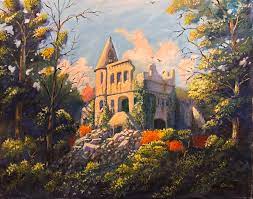
    Whichever was true, she knew he’d claim the whole town as his by right. When she gasped out loud at the sight of their new castle Ian rippled with the same lordly pleasure he demonstrated on skillfully dispensing an orgasm. There it was, at the end of a curving drive, Wyvern House, miniature alcazar toppling on its hill, as if the earth itself would sink beneath its weight.


    “My goodness,” she muttered, thinking, as she knew he did, how impressed future guests would be, especially if they could clear away the brambles, re-paint the gates and set the slipping wyverns more solidly, less threateningly aloft.


    Up close, the “castle” proved considerably less commanding, revealing unpointed brick, mucky stucco, bleeding windows and muddy drive. Over the double front doors was carved a date which threw it completely out of the running for any claim to aristocracy: “1892: Magnus Bronfen”.


    “Soap manufacturer,” said Ian. “All soap manufacturers dream of castles, apparently. How else could you get a castle and six acres for nine thousand pounds?”


    She shuddered at the sum. Neither his family nor hers had ever seen so much money. In their five years together they had barely cleared a thousand pounds, and owed more than that. If she succumbed to this place what time would be left for working out her complex themes of literature? She had seen nothing encouraging, so far, about the financial viability of her productions in general.


    Ian himself was not doing much better with his proposal for a “modern mythology” TV series. They would be thrown back on Ian’s first idea: using his supernatural “imp” to win a football pool. Or her secret, most private fancy; writing an explosive novel that told the truth about women’s experience. The one time she had mentioned it Ian had been very clear that he considered “women’s fiction” a literary disgrace.


    “Plus, the novel’s dead. Plays are the thing, Angry Young Men and all that. Look! There is a garden. You could start a market garden. I’ve heard these roses were famed far and wide.”


    What had she ever done to make him think she longed to garden? But “rosarian” certainly was a better title than “hausfrau.” Much better. At this time of year, the overgrown garden offered nothing to see, but it was walled; the walls covered with the same brambly vines that were eating up the gate. They should be replaced with, say, espaliered fruit trees. By somebody. Someday.


    To her relief, inside she saw an ordinary house without the unlivable discomforts of an actual castle. The front hall was rather splendid with a huge creaky oak staircase that shed sawdust (deathwatch beetle!) when walked upon but the large rooms were blessed with electric light and there were four generous bathrooms: three second floor and one down.


    “I don’t think they spent a penny on the place after building it,” said Scarlet.


    “I’m sure they didn’t,” Ian agreed. “This Magnus guy died almost immediately. The current heir lives in town – I don’t think he has a sou but what I gave him. He says the place has been for sale – slowly dropping in price — his entire life.”


    It always impressed Ian to consult a “magic moment”. He was beginning to think he was a magic moment, himself. A fatalistic man, with a strong sense of “destiny”, he’d carefully consulted his horoscope before marrying Scarlet. The stars, and a general English misapprehension that all Americans were rich, had pushed him over the edge.


    “He only has what the bank gave him,” Scarlet longed to correct, but didn’t. Their marriage was the envy of their friends because neither of them – ever gave in to cracks like that. Ian had repeatedly stated his opinion that “money” was an imaginary concept anyway, created in the modern world by mere promises to buy and sell. Failing to leap aboard the mad carousel, you made certain of being left behind.


    Sixty-six years without improvements or upkeep should certainly give any buyer pause, thought Scarlet. What Horrible Secret – probably more than one – was this house hiding? Drains? Vermin? As if reading her thoughts – which he probably was, because marriage made a person good at that — Ian continued,


    “Apparently the problem is the railways – having to change trains from London only to arrive in the middle of nowhere with eight miles to go. But now that everyone has a car that will change. By road, the distance from London is two hours, tops.”


    No one in their London group really “owned” a car, but everyone aspired to, so why point out that the drive had taken them three hours? Ian would only say it as because his pregnant wife needed to pee every five minutes and maybe it had been. Ian had acquired the station wagon (third-hand) because he’d acquired the house, launching them to the summit of their particular clique. As they walked from room to room Scarlet felt herself warming to this unlikely residence – it certainly had potential – and feeling a lot more forgiving towards her improvident spouse.


    The rooms were big, well laid out, and the mullioned windows vast and wonderful. There was even a room of empty bookcases clearly meant to be a library – what more could writers ever require?
    The dining room was a bit dark but the scullery was enormous. “If we updated the appliances we could eat in here,” said Scarlet. “It would be cozy.”


    Ian made a moue of disagreement. “Why neglect such a magnificent dining room? I mean, we’ve got one, why waste it?”


    “Keep it for special occasions,” Scarlet murmured. Most of the time it would be just the two of them and a baby, because they’d never be able to afford live-in help. Anyway, what couple ever benefited from intrusion on their togetherness? “Pas devant les domestiques” was the English byword.


    Three large rooms beside a dining room, scullery and butler’s pantry Scarlet counted, then upstairs were six bedrooms laid out rather unimaginatively around a poorly lit central hall with bathrooms connecting between them. Scarlet suggested they each take for a study the smaller bedrooms. But Ian claimed the library.


    “Those are kids’ rooms, don’t you think?” he disparaged.


    Scarlet felt a thrill that he even contemplated extra children. He hadn’t seemed the least excited about her pregnancy until his flicker of interest when the doula suggested it might be a boy.
    She was too well-trained to argue. “If you prefer,” she agreed. “Why don’t you take the library for your office and I’ll take the odd bedroom. For now.” She was determined to have the baby with them in their bedroom for starters, requiring her do up just one guest room. Seemed a good way to keep out an overage of guests.


    There was no attic whatsoever and the stairs to the tower were barred with a handwritten “Danger” sign.


    “I haven’t been up there,” Ian told her. “Pomeroy the Heir pronounced the stairs unsafe. I think we must assume the whole Tower is a disaster area. He suggested just cutting them out altogether, getting rid of that weak flooring and making it sort of a skylight where you can look up.”
    Trust a man to come up with such an idiotic idea.


    “I’ll investigate spiral metal stairs,” said Scarlet. “They come in modular one piece units and I know where we can get one cheap.”


    Ian snorted, “The more fools they, then, lowering the price just because their Tower was a fake.”


    Since they couldn’t go up, they went down, down to the “undercroft”, as Ian called it, not a “basement” but a magnificently warm, low-ceilinged room with winking-eye lights to the outdoors, shelves of bottled fruit, an empty wine rack and a huge furnace. Purring away. The furnace clearly was newer than 1892 – and if that was the case, the situation might not be as desperate as Ian had painted it.


    “I wonder if any of that fruit is still good,” said Ian.


    Scarlet’s spirits lightened. She felt a poem coming on.

  • The Pinch of Death – a mystery by Alysse Aallyn

    Chapter 36. Blessings & Mysteries

    The nuns gave Jacquetta a party. They gave her the “special dispensation” to “step over the rail” and mill about the parlor with them. Sister Elgarde baked a cake, and if it was a little too dense and packed with raisins the frosting was a gustatorial delight as well as a thing of beauty.


    They oohed and aahed over her business card for “A Sister in Need.” And it turned out each of them knew of a mystery; a dropped stitch from the skein of Time. Attics were stuffed and barns choked with the detritus and confusion left behind by the lost and missing.


    “My aunt Cinderella was taken to the State Mental Home when I was just a child,” Mother Xavier reminisced. “But when we went to visit her, she wasn’t there, and they claimed they never knew her.”


    Jacquetta produced a notebook and began to scrawl in the distinctive sketchy hand no one else could read.


    “They do say she was raped by her own father,” Mother Xavier hissed.


    “And Mrs. Molino, who helps out in the store, when she came to clear out her father’s house, it turned out the funeral director owned everything,” said Sister Hyacinth. “The funeral director!”


    “That can’t be right,” said Jacquetta.


    “And Reverend Cross’s nephew Bob went to Newark to take up a job and he was never seen again! His car gone and everything! Not a word and it’s been seven years,” complained Sister Philomena.
    “What did the police say?”


    Philomena shrugged. “That a twenty-three-year-old man is welcome to go anywhere in life that he wants. But Bob Cross wasn’t the boy to ignore his parents and sisters! Never!”


    The nuns were full of such stories. They took a card to put up on their bulletin board – a special sign of support and recommendation – and another to place by their phone. They toasted her in daffodil wine, and at the end of the party she knelt to receive their blessing.


    “May the road rise up to meet you and the wind always be at your back”, said Mother Xavier.


    “May it be a long road, a walkable road and not throw you off it,” quavered old Sister James-and-John.


    “It will certainly be interesting, whatever else it is,” prophesied Mother Xavier.


    “May the sun shine upon your face and all the little flowers,” said Sister Elgarde.


    “May you see your children and your children’s children and may all God’s children be your children,” said Sister Philomena.


    “And may God hold you in the Palm of His Hand,” blessed Mother Xavier.


    “Or Her Hand,” said Sister Hyacinth. “Whatever the case may be.”