Category: #VintageFilm

  • The Crimes of Woody Allen – a film review by Alysse Aallyn

    THE CRIMES OF WOODY ALLEN

    This film, probably his last, is not the movie to rescue the 88 year old filmmaker but it certainly marks an advance in his artistic life. Throughout his career, Allen has leveraged an apparently traumatically low self-esteem, inviting us to laugh at the hoops society forces ordinarily inadequate people to jump through for admiration, employment, companionship & love.

    As he matured, he began implying that society itself is a crime and we are its victims (Shadow & Fog, Crimes & Misdemeanors, Hollywood Ending, Match Point, Broadway Danny Rose, Cassandra’s Dream, Interiors, Irrational Man, Scoop, Manhattan Murder Mystery, Bullets Over Broadway.)

    I’ve come to believe he’s our Marcel Proust – sharply attuned to the pathos and ambition of our social signaling and teasing us with scandalous gossip about how far some of us might be willing to take our desperate impostures. What will we do to get what we want and what might we do when challenged?

    Throughout his career, he has presented beautiful young women as the ultimate desirable acquisition of the good life; otherworldly angels whose psyches are completely closed to him, but whose bodies he hopes to subjugate.

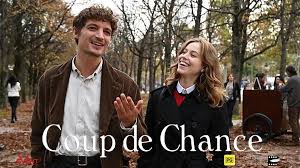
    Coup de Chance offers one of these mysterious creatures as its protagonist, a beautiful gallery worker “rescued” from her life with a shiftless musician by a wealthy, jealous man terrified of losing her. Yet she is bored, bored, BORED by his dull existence of object acquisition and gourmet travel and secretly falls for a handsome, exciting young man with a head full of dreams.

    This film was banned from Cannes as a show of solidarity with the credible accusations of sexual impropriety by Allen’s daughter, whose story as an adult and a child, has never varied. The persona who comes across in Allen’s stories is inquisitive and clueless and needy enough to have done what he is accused of, yet most of us will never know the truth. Creator of his own worst fears, he triggered their realization. “Exposed”, discredited and cast out; still he is making films.

    Artists we can unreservedly admire as human beings are rare, Picasso and Tolstoy and Byron, for example, displayed outrageously cruel, downright illegal behavior for all to see. But it’s quite possible that the sinner’s story is always the more interesting one from the perspective of our own humdrum lives. Certainly no one knows crime as intimately as a criminal.

    Unlike the brilliant Match Point, the intensely immersive Cassandra’s Dream, the creepy Crimes & Misdemeanors and the tour de force Irrational Man, Coup de Chance’s plot is a mere story board, lacking the three-dimensional richness this collaborative art usually supplies, but it closes with Allen’s final gift to us, the end philosophy of his lifetime of restless questing. His last word? That each of us is a lucky miracle and that life itself is a miracle we must learn to revel in and appreciate.
  • Film Review – The Three Faces of Alfred Hitchcock

    APOLOGY FROM ALYSSE – Somehow the first version of this came out in Plaintext! Sorry.

    Film Review: Spellbound

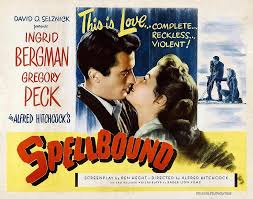
                A Viennese psychiatrist in this movie demands a dream “the more cock-eyed, the better” and Hitchcock obliges with this wildly uneven picture offering us Alfred at is best and worst. This film about psychoanalysis is schizy; pretentious, illogical, childish and afraid of its own emotions. Unfortunately it starts with an awkward, talky beginning in which misogynist doctors accuse Ingrid Bergman (for the first time in her life, I’m sure) of being a “glacier” who’s uninterested in men.

                No one heats up a screen like Ingrid Bergman, shooting smoke and fire in all directions from the get-go and it will surprise nobody to find out she and Gregory Peck conducted a hot affair during filming. 

                Dr. Constance Petersen is a psychoanalyst at an upscale Vermont looney bin full of nymphos and weirdos, galvanized by the arrival of Gregory Peck as the new doctor in charge and he’s just as worked up about her. It doesn’t even faze her to discover that he’s an impostor, the real Dr. Edwardes is missing and her swain is accused of his murder.

                The film begins to gather speed as the couple goes on the run together with Connie telling everyone they’re on their honeymoon.  She takes the amnesiac to her training psychotherapist’s house in Rochester where she promises to “cure” him.

                Her teacher tells her that “love smitten analysts playing dream detectives” make “the best patients” but she is making good progress breaking down Peck’s resistance when the police show up and the couple flees to a ski resort called “Gabriel Valley”. 

                The famous dream sequence designed by Salvador Dali is pretty interesting – gamblers in a club decorated with eyes, a man tumbling down a rooftop and a masked man laughing behind a chimney brandishes a wheel.  Constance interprets this as her boss murdering Edwardes on a ski vacation to prevent the younger man from replacing him and framing her lover for the crime.

                When she tells this discovery to her boss he threatens her with the very same gun, but she faces him down and he shoots himself instead. Seen from the killer’s perspective the gun fires directly at the screen.

                Film ends with Constance Petersen and her Big “100% Cured” male making out at the train station. To get to this point Hitchcock had to battle a sappy film score, (Bernard Hermann wasn’t available), a bossy, clueless, tone deaf producer (David O. Selznick) and a woman-hating screenwriter (Ben Hecht) to ignite a modicum of his signature passion and suspense. At least it was a huge hit and broke all records. What a film this could have been without the frozen art direction, the awkward rear projection and the hysterical film censors. Someone should definitely take another stab at it.