In spring of 1961 my father announced that he was giving up his job building public housing in Cleveland. He would be taking a position as Director of Refugees for the American Friends Service Committee in Morocco. We were to sell our house and almost everything we owned and move to Africa. I was only ten years old and my parents had a lot of explaining to do before I could even begin to understand. I had just been diagnosed with “myopia” and told I would need glasses for long distance vision and I was privately worrying about going blind. I recall asking Mom if we would be “poor” and she gave some needlessly confusing answer about how both she and Dad would be working for $50 a month. My sisters had started a pattern of ridiculing my fears so I could only find answers in books. Mom and Dad told us we could each take ten books on our move and gave us “carte blanche” at the College bookstore. I preferred history; somehow the disruptions in the lives of husband-seeking princesses sent to foreign courts seemed bizarrely comforting. We had to have a series of shots that sent us all to bed for a full day. I recall applying for passports while mothers’ friend swore, hand uplifted, that she had always known us and that we had no desire to sabotage or plot against the U.S.
We held a yard sale where I sold all my dolls and comic books. The cats and dog were given away. My friends were very excited that I was going to northern Africa and asked a lot of questions about the Sahara and Arabian horses that made the trip sound like it might be more of an adventure than a threat.
First, we flew to England to stay in a castle used as a Quaker conference center where Mom and Dad would receive training. At that time, I was reading about the French Revolution and was particularly taken by the Affair of the Necklace. Living in a castle – it had beautiful grounds – made me part of the story and only seemed appropriate. Then we flew to Switzerland to leave elder sister Merrill at the International School. Mallory had been enrolled at the Quaker boarding school at Barnesville, Ohio and Mom and Dad took it for granted that she would stay there while we travelled; but she absolutely refused, even contacting her congressman for help in springing her from that prison! Merrill still recalls all of us driving around Geneva crammed into a taxi looking for some family to take her in. Somebody had heard of a cleaning lady who might know someone who – etc. Since we were in Switzerland anyway, we might as well take a look at Mont Blanc. Dad rented a Peugeot, which he always said afterwards he had to kick up and down the Vosges Mountains; in Morocco, he made sure we had a Citroen with a special lever allowing it to ford streams! To get to Chamonix we had to take the Grimsel Pass, and it was grim, a sheer drop with no railing of any kind. We all sat as far as possible on one side of the car. But Chamonix was worth it.
We also saw Paris. Like most people, my sisters and I were stunned and seduced by the food. French breakfasts were a dream come true – chocolate in big drinking bowls, croissants, jam in elegant little earthenware pots, and curls of moist butter. Heaven! Picnics in the French countryside with bread, salami, cheese and iron-tasting mineral water. We saw Carcassonne, which is a living fairy tale. The streets erupted on Bastille Day – just in time for baby sister Avril’s birthday. She was thrilled to see an entire nation celebrating her birth with songs, fireworks, sparklers and parades.
My first sight of Morocco was very different from the desert I expected. There were fields of brilliant red poppies in bloom, hills dotted with stubby trees (sometimes with goats in them!) I was amazed by how people would stand unmoving in the road when a car was approaching, forcing the car to go around, and how children would come right up and speechlessly just stare. Berber girls were blue-eyed and clad in multiple wild colors while Muslim women wore full hijab with only their eyes showing. Their outfits looked very uncomfortable and hot to me but Arab girls my age didn’t seem to have to wear them, although grown men still looked at us strangely and became visibly excited by our Bermuda shorts. At one point Mom – wearing a straight skirt – was “goosed” by a man walking behind her. All this had to be explained to me by apologetic parents struggling to maintain compassion toward what they saw as crippling “medieval” religious beliefs.
Our house was in Oujda, a town on the edge of the Algerian border. Because the Algerians were waging a war of independence against the French colonialists, Arab refugees were pouring across the border and had to be housed in tents and encampments. Morocco bragged that it had avoided becoming completely French because of its strong monarchy (in the fifties, King Mohammed V reputedly threw a journalist to the lions.) The current king, Moulay Hassan II, had several feisty sisters who wore jeans and refused to take the veil. My favorite, Ayesha, was a wrecker of sports cars. Then there was the great resistance fighter, Jamila, tortured by the French. We heard many legends like this from local potentate, Moulay Suleiman, who entertained us to tea while his wives peered excitedly at us through a wooden screen. Tea was served in glass cups nestled in silver filigree holders; it was mint, bright green and at least half sugar. It was not my thing but we were warned to be polite. Moulay Suleiman invited us to a meshoui, the celebratory cooking of an entire sheep in a pit. Even the eyeballs and lungs are eaten. (The eye is a great prize.) We were also treated to the sight of armed horsemen in ceremonial dress riding straight at us, stopping inches away and firing their rifles in the air while shouting. It was impressive, and they would do it as many times as we wanted.
The Oujda house (Dar el Baraka, House of the Blessed) was enormous, a central tower ornamented with arrow slits and two big stuccoed wings in a 2-acre garden. The whole property was surrounded by a cement wall with broken glass cemented on top. The garden contained a guest house, (used only for storage), a garage (where the gardener and his wives lived) and swimming pool that a special town ordinance banned from ever being full. However, the garden had a complex set of irrigation ditches managed by the gardener Lakhdar. In the right wing lived a team of British nurses and Midwest Quaker volunteers. There was also a cook named Embarka who lived behind the kitchen with her son, Mujahed. Embarka was a fantastic chef; my favorite dishes of hers were rabbit stew with olives, and for dessert, chocolate balls – basically fudge rolled round and around in her hennaed hands.
The central tower contained an enormous two-story “salon” with two living areas, a long dining table with sixteen chairs and a fireplace the size of a mudroom. During the morning Embarka and her helper Fatima (Lakhdar’s youngest wife) would close the long interior shutters and swab the terrazzo floors with water; this kept the big room cool all day. The tower and rooftop terrace were reached by outside steps shrouded in brilliant bougainvillea; at night, the view of the stars was spectacular, and sometimes sister Genevieve and I were allowed to sleep up there.
Our rooms were in the left-hand wing, all three sisters together in one room with a big fireplace and its own bathroom. The bath had a hot water tank with a pilot light that had to be lit – “Boudagaz” – often singeing our eyebrows.
My sister Genevieve and I loved exploring the garden, which was always excitingly alive with bats, birds and feral cats. The guest house was full of boxes of onion-skin correspondence from previous tenants of the House of the Blessed, French colonialists bewailing their separation from the mother country. From our perch atop the wall we watched Lakhdar manage his irrigation ditches. Poor Avril, aged only six, wanting desperately to join our club, asked how we got up there. We told her we knew how to fly but we wouldn’t be teaching her. This caused her to break into the Grand Salon while Mom entertained ladies to tea, sobbing, “Genevieve and Alysse won’t teach me to fly!” Mom stomped out on the terrace shouting, “You teach Avril to fly this minute.”
We grudgingly tied Avril up in time-consuming paperwork to “join our club”, insisting she submit a urine sample. She brought us a glass of white port instead, which we deemed acceptable. Unfortunately, at that point my thirteen-year-old sister and a 22-year-old intern from the Midwest named Bill discovered each other and became boyfriend and girlfriend conducting a steamy 50’s affair, with no pushback from our deliberately blinded parents. I developed a relationship with one of the cats, who I named Christopher, and fed with scraps from our meals. Apparently, this made the other intern, a heartless, handsome and ideologically rigid idiot resolve to poison them all. Christopher, who had always refused to enter the house, crawled under my bed to die. I turned to Agatha Christie, who explained the heartless idiot perfectly to my eleven-year-old mind.
Then it was time for school. The world outside the walls was even more problematic. At our gate stood a licorice seller. The previous Refugee Director’s little boy sent us a “Missing you” postcard to deliver to him, but the hard, stuck-together clumps of licorice failed to gratify Genevieve and me, who preferred expensive French pastry sold at The Colombo. When translated into dirhams our allowance provided a very favorable exchange rate. The licorice seller also guarded the spot of a recent murder, showing off the gruesome bloodstain to passersby.
The schools spoke French. The previous director’s children had been home-schooled until their French was “perfect”, but Mom and Dad decided to throw us in at the deep end and hope for the best. Until we made friends, Jennifer and I were likely to have stones thrown at us by Arab children shouting, “Romains!”; slang for Westerners.
To attend school, you needed a “cartable” (briefcase) and a “tablier” (smock) purchaseable at a weird store right out of a Humphrey Bogart jungle equipment movie. They also sold block chocolate and warm Pepsi (nobody ever had ice.) “Lunch” was two pieces of French bread (small pieces) with anything between them. A chunk of cheese or chocolate was perfectly fine. Mine was struck out of my hand on the very first day and stepped on by a boy screaming wildly with delight. “Ha ha! Now you can starve!” Luckily, I acquired a wonderful friend – Zubeida Benkhala, who said her father was an Algerian general. And he may have been, because she lived in a big house and not the refugee encampment. I went to visit her after school one day and was a hit because I could sing the English version of “Ne Racroche Pas” (“Don’t Hang Up.”) The French would not associate with Arabs and since I associated with Arabs they would not associate with me. All of us had Arab friends, Avril’s was Karima Bouzidi and Genevieve’s was Salima. Arabs were friendlier.
School was terrifying. The teachers were physically abusive, the bathroom was a Turkish hole. When marched up to the blackboard, poor Avril just peed in front of everyone. We all learned enough French to get by; I began to dream in the language. My teacher, Monsieur Touati, couldn’t decide whether to make me his enemy or his pet, since I wouldn’t be his stooge. (I was not especially polite to adults.) After I left, he wrote to me, demanding pictures, when I sent one, he said it was too dark and he couldn’t see me properly. I think that was the end of our correspondence.
Life was enlivened by visitors and tourism. NY Times war correspondent Tom Brady was posted locally with his entire family; they invited us out to “watch the bombing” for entertainment after dinner. I found staring at explosions over darkened hills a dull experience but my father was impressed by Brady and considered him a celebrity.
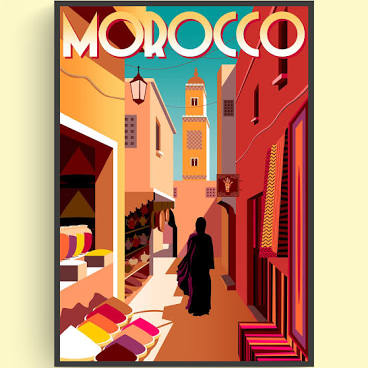
Another visitor was Quaker historian Paul Johnson and his wife, who introduced us to a monastery full of interesting and highly educated European monks. We visited the holy city of Moulay Idris where infidels (such as us) cannot remain after dark. We travelled to Meknes, Fez and Casablanca and visited all the souks where we learned to bargain for leather goods (all you had to do was threaten to leave.) We visited a leather-dyeing facility – glorious pools of deep color but the stench was so terrible we held handkerchiefs over our noses.
Most interesting was Melilla, a coastal city still belonging to Spain where we had to go through customs both in and out. Moroccan customs actually took down our tire identification numbers to make sure we wouldn’t buy new tires and fail to declare them! We travelled to Volubilis, gorgeous Roman ruins with huge storks’ nests atop the columns, saw the Sahara Desert and the Atlas Mountains with its snow and ski lodges, penetrated deep into the earth at the Grotte de Chameau (where I had a panic attack.)
Back home Genevieve played flute with the Oujda Philharmonic Orchestra and Avril took ballet; I read the Complete Molesworth and started a newspaper for the “inmates” of the Dar. Mom and Dad and the Quaker team taught sewing, carpentry and electrical wiring to the refugees and wanted to have a graduation celebration with food, games and awards. Jennifer and I gave a popular puppet show and the women danced. The next day we heard all the women had been beaten up by their husbands for dancing in front of foreign men. I began sleepwalking. It was spring and I was ready to leave Morocco. The French and Algerian war ended with an Algerian win. Ben Bella rode triumphantly through the streets while the women yu-yued from behind their hijabs. Mom and Dad and Avril prepared to move to Algeria. Genevieve would be sent to Plumly school, and I would be sent to live with my aunt, uncle and four boy cousins in Wayland, Massachusetts.
 Alysse Aallyn