Tag: #FilmReview

  • Film Review – The Three Faces of Alfred Hitchcock

    APOLOGY FROM ALYSSE – Somehow the first version of this came out in Plaintext! Sorry.

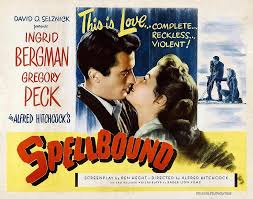
    Film Review: Spellbound

                A Viennese psychiatrist in this movie demands a dream “the more cock-eyed, the better” and Hitchcock obliges with this wildly uneven picture offering us Alfred at is best and worst. This film about psychoanalysis is schizy; pretentious, illogical, childish and afraid of its own emotions. Unfortunately it starts with an awkward, talky beginning in which misogynist doctors accuse Ingrid Bergman (for the first time in her life, I’m sure) of being a “glacier” who’s uninterested in men.

                No one heats up a screen like Ingrid Bergman, shooting smoke and fire in all directions from the get-go and it will surprise nobody to find out she and Gregory Peck conducted a hot affair during filming. 

                Dr. Constance Petersen is a psychoanalyst at an upscale Vermont looney bin full of nymphos and weirdos, galvanized by the arrival of Gregory Peck as the new doctor in charge and he’s just as worked up about her. It doesn’t even faze her to discover that he’s an impostor, the real Dr. Edwardes is missing and her swain is accused of his murder.

                The film begins to gather speed as the couple goes on the run together with Connie telling everyone they’re on their honeymoon.  She takes the amnesiac to her training psychotherapist’s house in Rochester where she promises to “cure” him.

                Her teacher tells her that “love smitten analysts playing dream detectives” make “the best patients” but she is making good progress breaking down Peck’s resistance when the police show up and the couple flees to a ski resort called “Gabriel Valley”. 

                The famous dream sequence designed by Salvador Dali is pretty interesting – gamblers in a club decorated with eyes, a man tumbling down a rooftop and a masked man laughing behind a chimney brandishes a wheel.  Constance interprets this as her boss murdering Edwardes on a ski vacation to prevent the younger man from replacing him and framing her lover for the crime.

                When she tells this discovery to her boss he threatens her with the very same gun, but she faces him down and he shoots himself instead. Seen from the killer’s perspective the gun fires directly at the screen.

                Film ends with Constance Petersen and her Big “100% Cured” male making out at the train station. To get to this point Hitchcock had to battle a sappy film score, (Bernard Hermann wasn’t available), a bossy, clueless, tone deaf producer (David O. Selznick) and a woman-hating screenwriter (Ben Hecht) to ignite a modicum of his signature passion and suspense. At least it was a huge hit and broke all records. What a film this could have been without the frozen art direction, the awkward rear projection and the hysterical film censors. Someone should definitely take another stab at it.
  • Film Review – “Stoker” by Alysse Aallyn

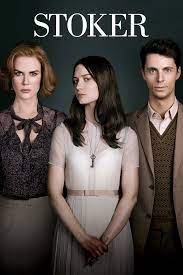
    Stoker – Arche-tripe

    Stoker’s screenplay started out as fan-fiction to Alfred Hitchcock’s much more enjoyable Shadow of a Doubt, which has a moral center, plus victims we care about and characters we can root for.

    Stoker has a good, even beautiful movie buried in it but park Chan-Wook kept messing it up, very deliberately, probably under the pressure (and pleasure) of his personal fetishes. It starts WONDERFULLY – psychologically interesting, visually compelling, achieving an apotheosis of eidetic perfection hen a shot of hair dissolves into quivering grasses but jumps the shark on story sanity. Anyone who want to write about crime (and criminal psychology) need to STUDY it carefully or they risk sounding like nine year old girls guessing about sex – majorly clueless and missing all the real points – ultimately creating an uninteresting world too obviously made up.

    Subjects like mental illness, spies, the foreign service, rituals of different countries, etc., can’t be persuasively invented, and threadbare simulacrums relentlessly reveal unpleasant truths about immature people who just don’t want their fantasies interrupted.

    I used to write fantasies, too, until I began an in-depth study of crime. It changed what I wrote, how I think about the world, even how I live my life. Devlyn is a fantasy – but Find Courtney can actually happen. (Versions of it already have.) This is the reason I usually don’t like sci fi. It is possible to completely make up a world – for example Alice in Wonderland – but if it doesn’t satirize the rules of the real one it collapses like a bad soufflé. Michelangelo felt he couldn’t create a credible physicality of angels without studying dead bodies in morgues.

    I understand that in Stoker our “Oldboy” doesn’t want to be “bothered” by all that stuff – he’s an “artist” who wants to create visual poetry so hypnotic it gets away with breaking the rules and it almost works! But by the end of the film real life insistently intrudes with its message that the “impossible” is ultimately boring.

    The acting in Stoker is very good – especially Matthew Goode who seemed creepily young and was almost perfect – he would have BEEN perfect if the director had allowed him to be a little less vampiric and a little less “ka-razy” and a little more human. That would have made him more appealingly believable. But of course everyone has to submit to becoming an “archetype” to satisfy this director. India Stoker’s amoral, murderous sexuality has been a fetish for middle-aged men seeking to relieve their guilt (and excuse their behavior) for literally HUNDREDS of years. “Some girls” don’t have “proper feelings” so can be ruthlessly used and heartlessly exterminated.

    Poor Mia Wasikowska! I have admired her ever since In Treatment with Gabriel Byrne – she deserves better. That said, I have to admit a personal failing – Nicole Kidman’s frozen weirdness always gets my back up. I have been rolling my eyes over her rigidity since Cold Mountain.

    Mostly I feel sorry for actors who are talked into limiting the range of their gifts by these visual directors who set out to make a cohesive, visually stunning objet d’art, not a complex story about humans. As proud professionals they know how to give the director what he wants, thereby betraying their actual abilities which could create something much more intriguing, provocative and mentally long-lasting.

    I watch a fair amount of crime and it’s always entertaining for me to speculate about how people could have gotten away with it. In this case, easily with a modicum of adulthood & sanity which seemingly bores our first-time scriptwriter (Wentworth Miller) who needs to be more “in your face”. Too bad. But I did enjoy seeing it because I relish being given a puzzle mistakenly assembled – in my view. Then I have the mental fun of putting it together more effectively myself – an amusing occupation for a winter afternoon Ah.