I always wanted to be a writer but writing felt almost too intimate ever to be my career. Other people didn’t seem to like it when I told the truth and always tried pushing me in a different direction. I kept a diary from the time I was nine years old and journaling became necessary to iron out my thoughts, develop them and see who I was becoming. From an early age my stories and poems didn’t meet much family support. If it wasn’t humorous, my parents weren’t interested. My father acted offended. “You wouldn’t want me to say it’s good when it isn’t, right?” My mother laughed her way through my short story about child sexual abuse: (To Bed in the Afternoon) “Isn’t it a joke?” School was more helpful because English teachers typically recognized and encouraged my gift. Fellow students, not so much. The areas I wanted to explore – personality contradictions, alienation, disappointment – were deemed pointlessly anarchistic. I read a lot and particularly liked mysteries involving masterful re-interpretations of confusing and frightening events. I remember excitedly opening Paul Goodman’s Growing Up Absurd recommended by a teacher but dropping it as soon as Goodman declared girls were not subject to any of the pressures he described. Idiot!
I was particularly frustrated at Plumly, my Quaker boarding school, which was reputed to be educationally advanced. Their slow crawl through the likes of Steinbeck, London and Melville threw me into full rebellion. I did not encounter a single memorable writer in the English syllabus there and lobbied unsuccessfully for the inclusion of at least some women writers (my paper on Francoise Sagan was frigidly received.) When I complained to my parents, they joked that maybe I’d be happier at Catholic military school. It seemed I was going to have to construct my own education. The nineteenth century proved a good place to start – blazing with impressive women writers – ultimately bearing fruit in my first novel, Devlyn.
My experience at Plumly was so bad I couldn’t imagine going straight to college but took a “gap year” flirting with acting and dance. Fame would be nice, but what I secretly hoped for was fulfilling and supportive romantic love. I was able to talk my parents into paying for an apt on West 56th Street in New York City where I enrolled at Circle in the Square Theatre School and the Martha Graham School of Dance. Even though I got the lead in the acting class play I thought I was horrible and I was never happy expressing other people’s ideas that I couldn’t agree with right when I was trying to figure out my own ideas. The most profound memory I have of that period was feeling people trying to control me and me not wanting to be controlled. But could freedom be found? My own background strongly suggested marriage was a place where I could flourish – once I found someone who loved me and believed in me couldn’t I let my husband worry about the money? That seemed to be something men naturally wanted to do, while my knowledge of Mom’s Chestnut Hill friends was of women living in artistic paradises created by their own hands. Sure looked good to me!
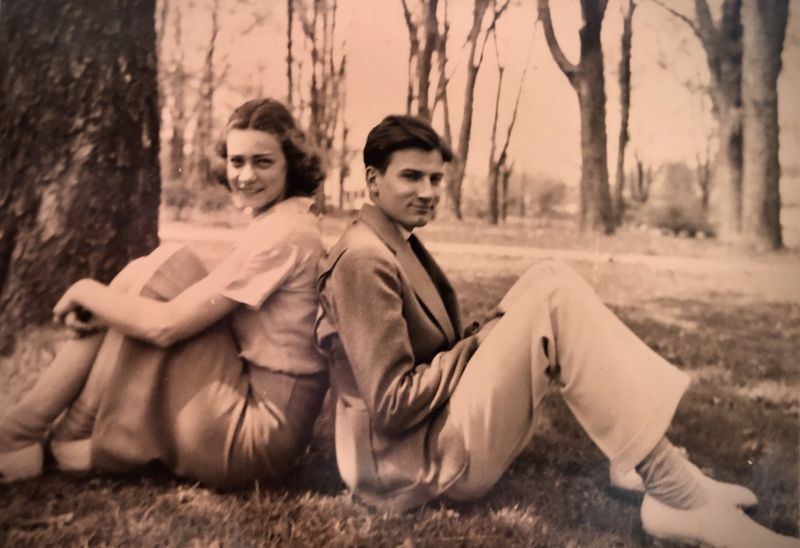
My first boyfriend after Plumly’s Toss was an actor named Armon Hyle. He was talented theatrically and deeply sensitive and artistic. I followed him to Lawrence University but persuaded him to transfer to Antioch in Maryland where I could study writing – and there I ran into my first husband, the multi-talented Bruce Burke.
Bruce was a musician and a writer and dripped with charm. In fact, my writing teacher far preferred his writing to mine although I was fairly certain she was really ensnared by his beauty, as most people were. I considered Bruce’s poetry “masculinist” (i.e. idiotic) and I stalwartly refused to be critiqued by him, or even by my writing teacher who kept trying to make me “write like The New Yorker.” (Later she hired me to ghostwrite a novel for her. It was called The Colors of Love if I remember right and we did ell it but I thought it was pretty ghastly dreck.) I was struggling to write a novel about adolescence that tried to expose the general craziness of non-conforming parents who want you to conform, but I kept tripping over the Problem of Sexuality and was getting nowhere. I also wrote awful (feminist) poetry attempting to skewer my fluctuating psychological and emotional states. My job at the time was as the only paid employee of a community theatre whose director was a predatory sexual harasser. My relationship with Bruce kept him in check. Bruce had a band, Bad Heart, which played all over Maryland and DC on the same bill with better known musicians like Emmylou Harris and Judy Collins. It was fun travelling to David’s concerts, getting to know musicians, roadies, groupies and especially his charming manager, Bubbles (who used to tell me, “Alysse, you need to get your gothic ass in gear.”)
Bruce was older; he’d been married and divorced, been to Vietnam, been to jail. When he asked me to marry him I was elated. Marriage was in particularly bad repute at the time, but I thought my parents might accept him, which they grudgingly did. Our fun wedding at the Quaker Meeting on Jan 1, 1972 was everything I wanted, except that the harmonium player couldn’t make it through the snowstorm, and afterwards we drove to Vermont to stay with one of his roadies at a ski chalet. Right away, Bruce and I clashed. What I thought would be a ski weekend was actually a drug weekend and I refused to participate. Bruce was irked. According to him, you HAVE to do what everybody wants to do. But I had spent my entire life resisting that!
So after the wedding I discovered that my husband was a man who simply said anything other people wanted to hear. I was completely unprepared for somebody like that; I had been taken in, like everyone else. He talked my father into investing in his band, he talked a friend into investing in his album, he never did any of the things he said he was going to do with the money, always leaving me to apologize (and grovel), picking up the pieces.
He wanted to be where the action was, but I wanted to live in the country where I could write my novel. Almost immediately after our marriage his mother died, and using their tiny inheritance, he and his brother bought a farm in Devil’s Elbow, New York where real estate was incredibly cheap. The peace and quiet was just what I had been looking for. I immediately plunged into a novel about a lesbian relationship (Flycatcher.) It was really about the relationship of a mother to an unacceptable daughter, and the mother’s search for a perfect daughter but it was painfully inchoate. In the meantime, Bruce was touring, taking drugs and being unfaithful because “that’s what everyone expects.”
Our marriage, his relationship with his brother and with his investors were all on the rocks, so we sold the farm and moved back to Maryland to complete our college degrees. I needed a job and I needed to get rid of Bruce – I told him he could have the rest of the house money if he would just split, which he happily did. He had some bridges in England he needed to burn.
It wasn’t till my parents offered a housesit in Maine that I was able to actually complete and sell a novel, but although it sold 100,000 copies (paperback) it didn’t provide the kind of money you could actually live on. Worse, the publishing connections I had made assumed I would write to specification, while I had a whole psyche left to explore! Once again, marriage (much happier this time) and children (who turned out to contain the secret of the meaning of life!) intervened.
I wasn’t able to work on my second novel until 2002. I had been studying true crime for the past decade, increasingly intrigued and absorbed: here were ready made, real plots that explicated the very questions of identity, self-presentation, power, truth will and justice that had always obsessed me. With Find Courtney, I was off and running – and to my intense artistic satisfaction, Woman Into Wolf, Depraved Heart and I’ll Sleep When You’re Dead quickly followed with fabulous reviews. Unimpressive sales led me back to the theatre, where one forges a more immediate connection with the audience. With every play, The Honey & The Pang (Emily Dickinson), Queen of Swords (murderous stepmother), Cuck’d (Othello), Caving (quantum physics), Rough Sleep (the multiverse), The Dalingridge Horror (Virginia Woolf) I find out more and more about myself and the world I’m living in. Writing full-time to please yourself is the greatest joy there is.